
UX Case Study · AI & Service · 2024
SnapGuard
A gamified reporting system that helps Snapchat’s My AI users spot and flag bias in generative AI — turning a hidden problem into a shared responsibility.

my role
UX Designer, UX Researcher
timeline
January – May, 2024
company
Snapchat
User-Centered Research & Evaluation Team —
Airla Fan
Estee Goel
Yining He
Michelle Jia
Tian Zhou


The process, by the numbers
5
designers & researchers on the team
3
data-backed insights from the TAIGA WeAudit dataset
10+
research & ideation methods, from heuristic evaluation to speed dating
4
core design principles validated through speed dating, before we built anything


See it in action
Reporting bias, gamified: five connected screens that make flagging My AI content as easy as sending a Snap.

Home page
— Clearly visible and easily accessible report button next to My AI
— My AI Bitmoji is clearly differentiated from friend list to avoid confusion

Report Interface
— Simple and easy to navigate one page report system
— Optional sections to give more detail about the bias being reported

Status & Navigation
— New status feature when the user completes a report
— Navigate to leaderboard, unlocked prizes, and reporting status
Community Reports Leaderboard
Service
LTE
See what the rest of the Snapchat community is doing to help make Snapchat a safer place for everyone!
Connect
level 8
202 reports made
Helen
.
level 8
202 reports made
Helen
.
Connect
Connect
level 7
187 reports made
Bill
.
.
level 6
120 reports made
Amanda
.
.


As someone who believes in gender inclusivity, it's disheartening to encounter such oversimplified perspectives in a platform as influential as Snapchat
As a member of the LGBTQ+ community, it's disheartening to encounter instances where platforms fail to acknowledge and celebrate our diverse identities
As someone who values transparency and open dialogue, I hope Snapchat AI can rise above political biases and foster meaningful conversations.
1
1
2
2
2
3


Leaderboard
— Community report leaderboard to see what other users are saying
— Users can like, reply, and connect with other auditors they resonate with
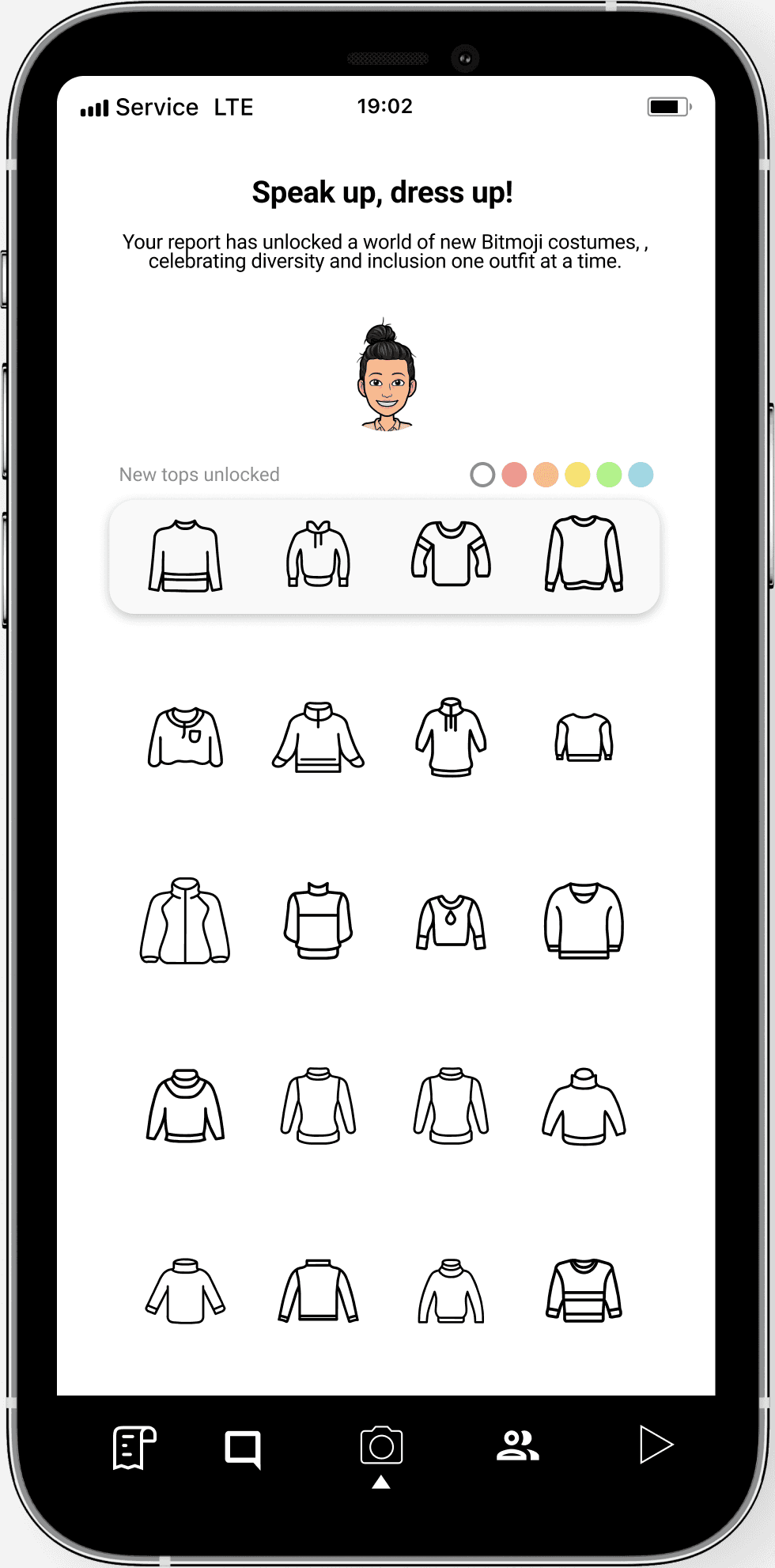
Rewards
— Bitmoji costumes unlocked when a report is made
— A gamified system where users peruse newly unlocked costumes


Research
Background Research
→
Contextual Inquiry
→
Affinity Diagramming
→
Empathy Maps
→
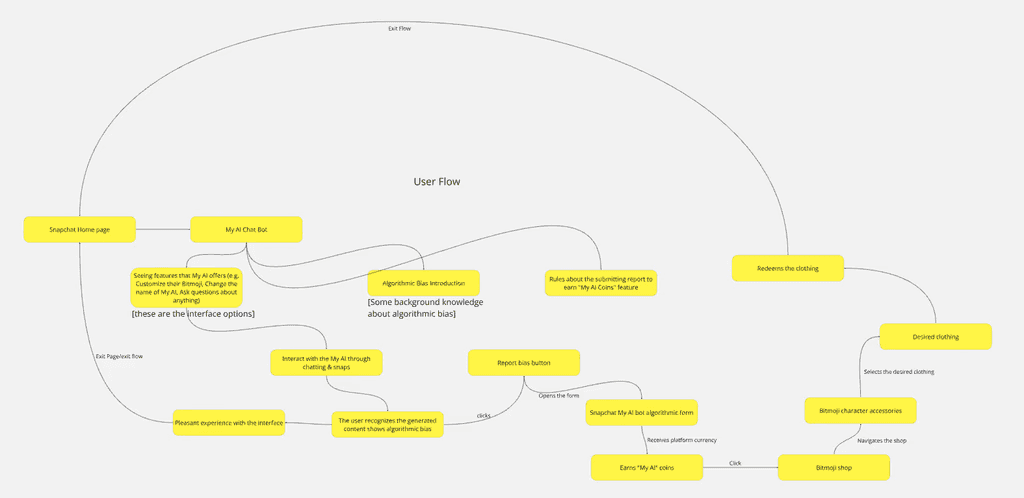
User Journey Flow
Usability Testing
←
Speed Dating
←
Story Boarding
←
Crazy 8s
←
Reverse Assumptions
As artificial intelligence becomes increasingly integrated into platforms and programs, it’s essential to recognize and address the biases embedded in these systems. Our challenge: explore ways to foster a safer environment for AI interactions while motivating users to report any biases they encounter.
Primary research, on TAIGA WeAudit
We were given the platform TAIGA WeAudit to understand the context of algorithmic bias. We ran data analysis on WeAudit’s user dataset, a heuristic evaluation of the platform, and usability testing to identify gaps in what users understood.
Based on the data analysis, gender significantly influences perceptions of harm — women generally perceive images as more harmful than men.
Irrespective of race or gender, people detect subtle harm in images more readily than significant harm or no harm at all.
There’s a strong correlation between awareness of societal bias and the perception of harm in algorithmically generated images.


Walking the Wall
We ran an activity called “Walking the Wall,” grouping findings and observations into breakdowns and needs — then used those clusters to form the questions that pushed the project’s direction.

Emphasizing target users
We interviewed Snapchat users directly, then used affinity diagramming to group their needs and concerns — and built an empathy map and user journey to pinpoint exactly where AI bias was hurting the experience.



Design process
We began with background research and evaluations to understand algorithmic bias, then moved to user research to uncover needs and inform solutions — using structured frameworks throughout to organize findings and generate ideas.
1. Ideation — Crazy 8’s & storyboards
Crazy 8’s helped us rapidly brainstorm risky, interesting concepts. We turned those into storyboards and tested them on users through speed dating to see how each idea actually landed.


After testing the riskier ideas, four key insights narrowed our direction:

2. Prototyping
Users wanted a more interactive, streamlined reporting process and gamified incentives to stay motivated — with validation and impact, not extensive human interaction. We balanced educating people about bias with keeping the app fun and social.
where we landed
Gamifying the bias-reporting process itself — turning every report into progress the user can see, on a Bitmoji-costume ladder they actually want to climb. We built lo-fi wireframes to show how it would work end to end.


Meet the team



Airla, Estee, Yining, Michelle & Tian


say hi
Let’s get in touch!
Would love to talk projects, collaborations, or anything design!